Kubernetes Security Basics: A Pentester's Guide
Release Date: June 15th, 2025
Introduction
Kubernetes (K8s) is a leading platform for orchestrating containerized applications, enabling scalability and automation. However, its complexity introduces significant security risks. This guide, tailored for Aegisbyte's audience, explores Kubernetes security from a penetration tester's perspective, highlighting key vulnerabilities and best practices to secure clusters.
Understanding Kubernetes Architecture
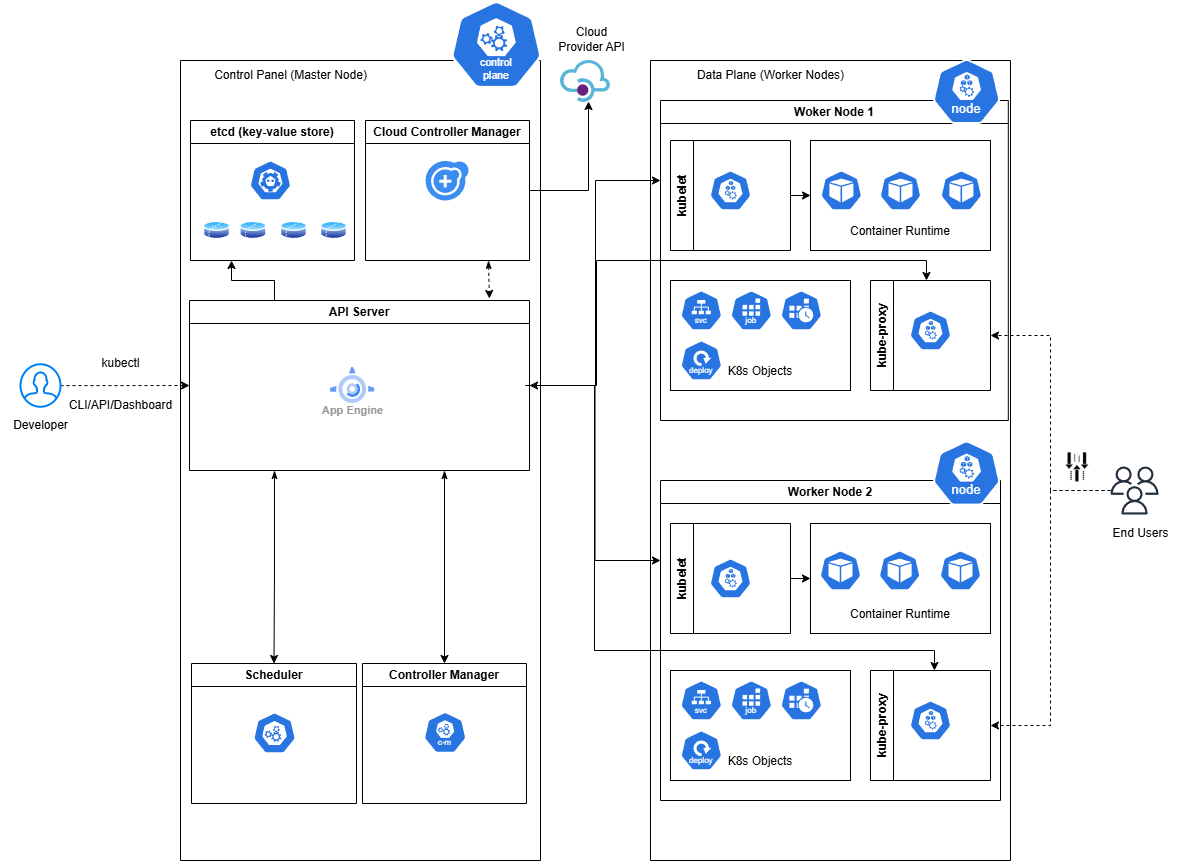
Kubernetes operates as a distributed system with components that manage containerized workloads. Key elements include:
- Control Plane: Manages the cluster, comprising:
- API Server: The central hub for cluster communication.
- etcd: A key-value store for cluster data.
- Controller Manager: Oversees controllers for maintaining desired states.
- Scheduler: Assigns workloads to nodes.
- Worker Nodes: Host application workloads, including:
- Kubelet: Manages containers on a node.
- Kube-Proxy: Handles networking and load balancing.
- Container Runtime: Executes containers (e.g., Docker, containerd).
- Pods: The smallest deployable units, containing one or more containers.
This architecture, while powerful, exposes attack surfaces if misconfigured. For example, an exposed API server or overly permissive Role-Based Access Control (RBAC) can lead to cluster compromise.
Kubernetes Architecture
Common Attack Vectors
Penetration testers target several areas in Kubernetes clusters:
Misconfigured RBAC
Overly permissive roles or cluster roles allow unauthorized access to resources.
Example: A service account with cluster-admin privileges can be exploited to control the entire cluster.
Exposed Control Plane
Unsecured API servers (e.g., open to the internet without authentication) allow attackers to manipulate cluster resources.
Default credentials or weak authentication mechanisms are common vulnerabilities.
Pod Security Issues
Privileged pods or containers running as root can enable container escape attacks.
Misconfigured security contexts may allow attackers to access host resources.
Network Vulnerabilities
Lack of network policies can allow lateral movement within the cluster.
Exposed services via insecure ports or misconfigured ingress controllers are entry points.
Secret Management
Secrets stored in plain text or accessible via misconfigured RBAC can leak sensitive data like API keys or database credentials.
Secrets are often a prime target for attackers seeking to escalate privileges.
Penetration Testing Methodology
A structured approach to pentesting Kubernetes clusters includes:
Reconnaissance
- Identify exposed endpoints (e.g., API server, kubelet ports) using tools like nmap or kube-hunter.
- Enumerate cluster resources with tools like kubectl to map roles, services, and pods.
Access Enumeration
- Check RBAC policies for overprivileged roles using tools like KubiScan or rbac-tool.
- Look for service accounts with excessive permissions (e.g., ability to create pods or access secrets).
Exploitation
- Attempt to exploit misconfigured RBAC to escalate privileges.
- Test for container escape by exploiting privileged pods or misconfigured security contexts.
- Access sensitive data via exposed secrets or misconfigured storage.
Post-Exploitation
- Move laterally within the cluster by exploiting weak network policies.
- Persist access by creating backdoors (e.g., malicious pods) or modifying existing workloads.
Kubernetes Threat Matrix
The Microsoft Threat Matrix for Kubernetes provides a structured framework for understanding attack techniques across the MITRE ATT&CK lifecycle. Key categories include Initial Access, Execution, Persistence, Privilege Escalation, Defense Evasion, Credential Access, Discovery, Lateral Movement, Collection and Exfiltration.
This matrix, adapted for Aegisbyte, is implemented as an interactive component below to help visualize and prioritize threats. Click on any technique to see more details about that attack vector:
Microsoft Threat Matrix for Kubernetes
Interactive exploration of attack techniques across the MITRE ATT&CK lifecycle
Attackers exploit unsecured API servers to gain cluster access.
Stolen tokens or certificates provide unauthorized access.
Running malicious code within a pod.
Exploiting misconfigured containers to access the host.
Deploying malicious pods for sustained access.
Altering roles to maintain control.
Exploiting accounts with excessive permissions.
Using misconfigured cluster roles to gain higher privileges.
Evading Pod Security Standards or policies.
Turning off audit logs to hide activities.
Accessing sensitive data from Kubernetes secrets.
Stealing service account tokens from pods.
Listing pods, services, or roles to identify targets.
Discovering network policies and open ports.
Exploiting weak network policies to access other pods.
Moving from a pod to the underlying node.
Gathering sensitive data from pods or storage.
Transferring stolen data out of the cluster.
Best Practices for Securing Kubernetes
To mitigate risks, implement these security measures. Click on any practice for detailed implementation steps, security impact, and additional resources.
Interactive Tools for Pentesting and Hardening
These tools help security professionals test and secure Kubernetes environments. Click on each tool to view installation instructions, usage examples, and documentation links.
Filter tools by category:
Kube-Hunter
Identifies vulnerabilities in Kubernetes clusters by actively hunting for security issues.
KubiScan
Analyzes RBAC configurations for risky permissions that could lead to privilege escalation.
Trivy
Scans container images for vulnerabilities, helping prevent vulnerable containers from being deployed.
Kube-Bench
Checks compliance with CIS Kubernetes Benchmarks, providing guidance on hardening.
Falco
Provides runtime security monitoring, detecting anomalous behavior in containers and hosts.
Kubeaudit
Audits Kubernetes clusters for common security issues and misconfigurations.
Conclusion
Kubernetes offers immense flexibility but demands rigorous security practices. By understanding its architecture, mapping threats using the Threat Matrix, and applying best practices, organizations can secure their clusters against attacks.
Aegisbyte recommends regular pentesting and continuous monitoring to stay ahead of evolving threats. The complexity of Kubernetes requires a defense-in-depth approach, addressing vulnerabilities at multiple layers.
For more information on securing your Kubernetes environments or to schedule a security assessment, contact Aegisbyte at security@aegisbyte.com.
References
Stay Updated on Kubernetes Security
Subscribe to receive the latest documentation updates, vulnerability notifications, research findings, and proof-of-concept demonstrations from our security experts.